For years, the advice for a local business dipping a toe into paid advertising was simple: start with Google Ads, because that’s where people go when they’re actively looking for what you sell. That advice hasn’t disappeared — but it’s no longer the whole story, and the numbers coming out of 2026 show why.
The shift that’s already happened
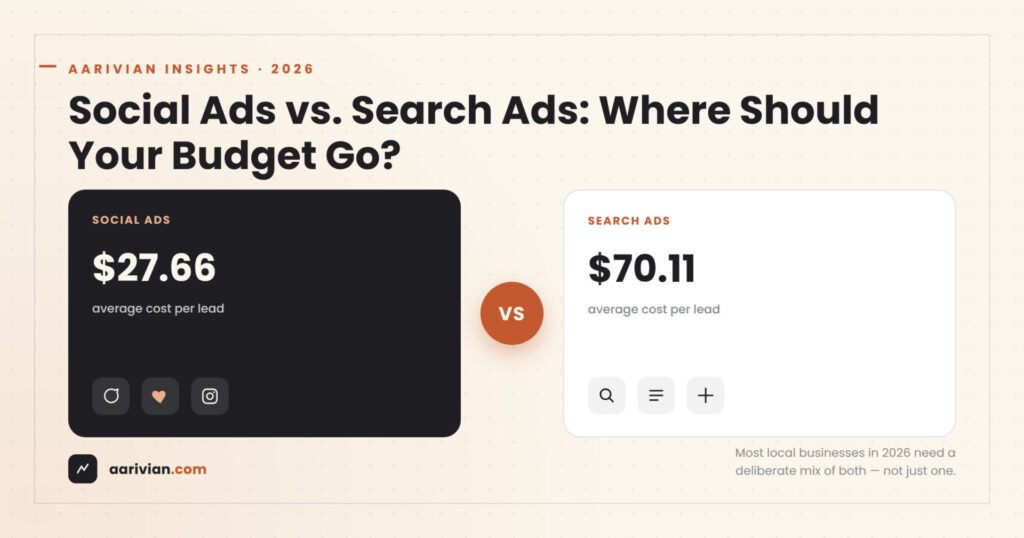
More small businesses now run ads on social platforms than on search. It’s a genuine reversal of the pattern that held for most of the last decade, and it isn’t happening for sentimental reasons — it’s happening because of cost. A lead from a Facebook-style ad currently costs a small business less than half of what a comparable lead from Google search advertising costs. When budgets are tight — and as covered in our look at 2026 marketing budgets, most small businesses are working with under $1,000 a month — that difference is hard to ignore.
Why search still isn’t obsolete
None of this means Google Ads has stopped working. Search advertising puts your business in front of someone at the exact moment they’re typing “plumber near me” or “best [your service] in [your town]” — that’s about as close to a captive, ready-to-buy audience as advertising gets. The intent behind a search click is fundamentally different from the intent behind a scroll-stopping social ad, and for some businesses — especially ones selling something people actively search for by name — that intent is worth the higher cost per lead.
The honest answer to “social or search” is almost never “pick one forever.” It’s “know what each one is actually good at, and match your budget to your goal.”
When social ads make more sense
- You’re building awareness, not just capturing existing demand. Social platforms are built for discovery — someone who’s never heard of your business can still end up as a customer because your ad showed up in their feed at the right moment. Search can’t do that; it only works for people who already know to look for you.
- Your budget is limited. With lead costs running well below search, a small ad budget stretches further on social — which matters when, as the data shows, half of small businesses have no dedicated marketing staff and every euro needs to earn its keep.
- Your product or service is visual. Food, retail, events, home renovations, anything with a strong “before and after” — these all perform well in a scrolling feed in a way a text search ad never can.
When search ads make more sense
- People already search for what you do. If there’s meaningful search volume for your service plus your city or neighborhood, that’s demand you don’t want to leave for a competitor to capture.
- You sell something people research before buying. Higher-consideration purchases — legal services, specialized repairs, anything with real stakes — tend to convert better from someone who typed in exactly what they needed, versus someone who was just scrolling.
- You want to defend your own name. If competitors are bidding on searches for your business name, a modest search budget protecting that territory is often worth it on its own.
The real 2026 answer: most local businesses need both — run well
The businesses getting the most out of their ad spend this year aren’t choosing one platform and ignoring the other; they’re running a deliberate mix and putting more weight behind whichever channel is actually converting for their specific business. That’s a reasonable strategy on paper — and also exactly where a lot of local businesses run out of hours in the day. Managing creative, budgets, and performance across two or three ad platforms at once is a real, ongoing job, not a one-time setup task.
That’s the gap Korvify exists to close: one flat monthly plan that manages your campaigns across Google, Meta, and TikTok together, so the channel mix gets decided by what’s actually working for your business rather than by which platform you happened to have time to log into this week.
A simple way to decide where to start
If you can only start with one channel today, ask yourself:
- Do people already search for what I sell, by name or by category, in my area? If yes, put some budget toward search first.
- Would someone recognize the value of what I offer the moment they saw it, even if they weren’t looking for it? If yes, social is likely to outperform on cost per lead.
- Is my budget under roughly $500–1,000 a month? Lean social first for volume, and add search once you have room to defend brand-name searches too.
Whichever you start with, make sure your website is ready to receive that traffic before you spend a single euro on ads — a great ad campaign sending people to a slow or unclear website is money spent proving your ads work, and your site doesn’t.
Sources: LocaliQ — The Big Small Business Marketing Trends Report for 2026; Constant Contact Q1 2026 Small Business Now report, via PR Newswire