If you’ve been watching prices climb and wondering whether this is really the year to spend more on marketing, you’re not alone — and the data says you’re actually in the majority when it comes to what business owners are planning to do about it, even if it feels counterintuitive.
The uncertainty is real
Economic uncertainty is the single biggest worry for small business owners heading into 2026, with two out of three citing it as a serious challenge — a sharp jump from just a year earlier. Inflation specifically is named as the top concern by more than four in ten owners. None of that is surprising if you’ve looked at your own supplier invoices or rent renewal lately.
But almost nobody is cutting marketing
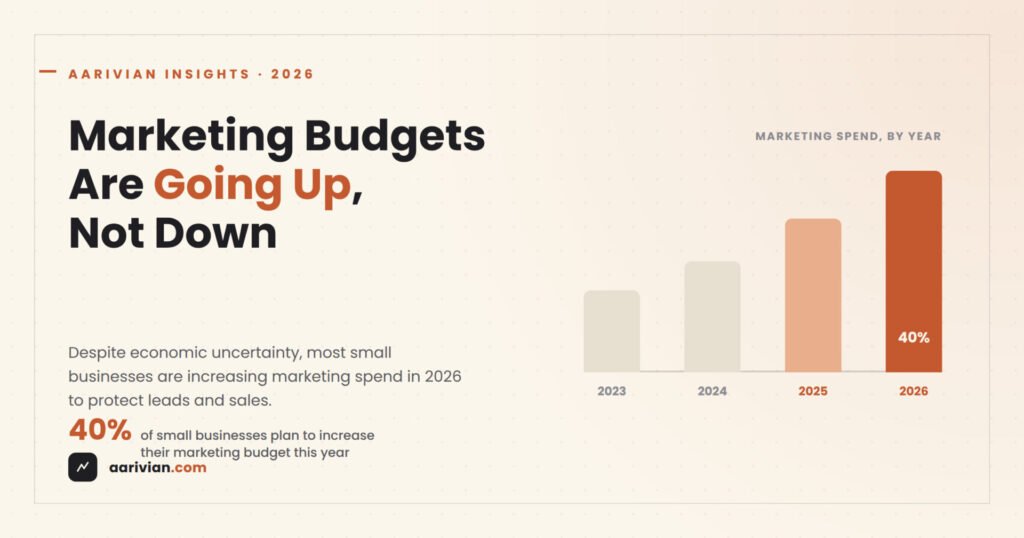
Here’s the part that catches people off guard: despite that anxiety, only a small minority of small businesses plan to shrink their marketing spend this year. Most are holding steady, and a large share — around four in ten — are actually planning to increase their budgets specifically to protect leads and sales. Many owners also expect to spend more of their own time on marketing this year, not less.
The logic isn’t complicated once you think it through. When money is tighter for everyone, customers get more selective about who they buy from. The businesses that stay visible, stay top-of-mind, and keep showing up in searches and social feeds are the ones that keep the phone ringing when a slower economy makes every customer decision a little more deliberate. Marketing in a downturn isn’t a luxury — it’s how you protect the revenue you already have.
Where the smart money is actually going
A few patterns stand out in how small businesses are allocating this increased spend:
Social media ads are now outpacing search ads. More small businesses run ads on social platforms than on Google-style search ads today, largely because the cost per lead is meaningfully lower on social — often less than half of what a comparable search lead costs. That doesn’t mean search is dead; it means the smartest budgets are splitting spend across channels instead of betting everything on one.
Budgets are still tight, and that’s forcing better decisions. Over half of small businesses run their entire marketing operation on less than $1,000 a month, and half don’t have anyone on staff whose job is marketing. That’s exactly why owners lean so heavily on organic tactics — social posting, SEO, and email — alongside whatever paid spend they can justify. Every euro has to work harder when there’s no dedicated team to babysit a campaign.
Video keeps climbing the priority list. More than half of businesses that haven’t invested in video yet say they plan to start in 2026, alongside continued investment in SEO and content. Attention has shifted toward platforms and formats where people actually stop scrolling.
What this means if you’re deciding where to put your next euro
You don’t need a big-agency budget to compete — you need your spend to be deliberate. A few practical takeaways from the numbers above:
- Don’t concentrate all your spend in one channel. If social ads are pulling in leads at a fraction of the cost of search, at least test a split rather than assuming the channel you’ve always used is still the best value.
- Protect your website as the foundation. Every ad, every social post, and every referral eventually sends someone to your website. If it’s slow, outdated, or doesn’t clearly explain what you offer, you’re paying to send traffic to a leaky bucket.
- Treat marketing as ongoing, not a one-off project. The businesses increasing spend this year aren’t launching a single campaign and walking away — they’re building a steady presence across search, social, and their own site.
- Get help where it’s worth it. Running paid campaigns across multiple platforms well takes real, ongoing attention — creative, budgets, targeting, reporting. If that’s more than you or your team can keep up with alongside everything else running a business demands, it’s worth handing that piece to someone who does it full-time rather than letting it fall to whoever has a spare hour.
This is exactly the gap a service like Korvify is built for — managing ad campaigns across Google, Meta, and TikTok for local businesses under a single flat monthly plan, so you get a consistent presence across channels without needing to hire or train anyone in-house.
The bottom line
An uncertain economy doesn’t mean it’s time to go quiet. It means it’s time to be more intentional: a strong website as your home base, a deliberate mix of paid and organic channels, and consistency over the course of the year rather than a single burst of activity. The businesses that treat 2026 as a reason to disappear are the ones that will feel the downturn the hardest — the ones that stay visible are the ones still standing when things turn around.
Sources: LocaliQ — The Big Small Business Marketing Trends Report for 2026; Constant Contact Q1 2026 Small Business Now report, via PR Newswire